


At a time when our own government is at war with higher education, cutting billions of dollars in funding; radically shifting research priorities; and leveling a barrage of policy changes and legal actions striking at institutional autonomy, admissions and hiring practices, campus culture, and curriculum and classroom teaching, college leaders across the country have faced the difficult challenge of deciding whether, when, and how to speak up or fight back.
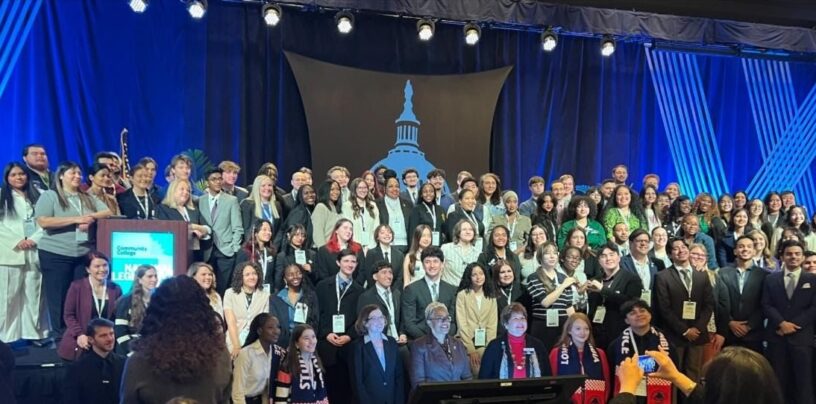
In the midst of the chaos, this week offered some moments of clarity and inspiration, as I joined hundreds of college presidents, trustees, and students in Washington, DC for the Association of Community College Trustees National Legislative Summit; followed by a compassionate, wonderfully wonky policy convening with Campus Compact, a national organization dedicated to higher education civic and community engagement.
Advocating for community college students with community college students in the halls of Congress is one of the great privileges of any president’s job; and if you don’t leave a meeting with your senator or representative hopeful for the future of our nation after hearing your students share their stories of aspiration, struggle, and accomplishment, then your heart simply isn’t beating in your chest.
Similarly, if you don’t feel called to action on behalf of your students and the communities you serve after hearing from the presidents of Minneapolis colleges that have been providing food assistance to local Somali residents afraid to leave their apartments because of the violence against immigrants in their streets, then it may be time to rethink your career path.
Still, geography is destiny in many ways, and some presidents are rightly fearful of the retribution they and their institutions may face not only by an administration in Washington eager to punish, but sometimes by their state legislatures or governing boards. For them, giving voice to the voiceless can end abruptly, with potentially devastating consequences for the colleges they lead.
So, each of us must choose how to speak up for higher education in ways that will work best for our students and institutions.
In 2018, I was named the National Pacesetter of the Year by the National Council for Marketing and Public Relations (NCMPR) for my advocacy work for community colleges and our students. My moments of clarity and inspiration in DC this week reminded me of an article I was asked to write for the organization’s magazine, NCMPR Counsel, and what I wrote seems even timelier today than it was in back then.
Speak Up for Higher Education
Not long ago, Robert Hildreth, a prominent Boston area entrepreneur, philanthropist, and educational activist, scolded the city’s elite university leaders in an editorial for Commonwealth Magazine headlined, “Hey, college presidents, speak up!”
As Hildreth sees it, there was a time when “Boston area presidents took positions against slavery and McCarthyism. James Bryant Conant of Harvard revolutionized higher education from centers of privilege to become meritocracies. Boston University’s John Silber spoke frequently about reforming education when he ran for governor.”
But now, he laments, at a time when the city (and the nation) may need them the most, only silence.
If so, there are plenty of reasons for this: The job of college president has become far more complex, while public support for higher education is declining rapidly. Taking a visible stand on an issue risks alienating lawmakers, donors, trustees, students, and their families; and can lead to protests, votes of no-confidence, declining enrollment, withering fundraising campaigns, or even an abrupt end to a career.
But responsible risk is part of leadership, and no matter what institution a president leads, there are times and topics that call for taking a stand. When that time comes, community college presidents are often uniquely qualified to speak up and advocate on issues that matter most to their students and the local communities they serve.
My own work as president of a mid-sized community college north of Boston has led me to make appearances and take public stands on issues, to write editorials and blog posts with decidedly strong perspectives, to actively lobby for state and federal legislation, and to get involved in local, community-based socio-economic development initiatives that may not seem to be part of my job description—but that are vital to our students and communities.
To help me speak up effectively for my college, I have adopted some principles to guide my work:
Know when and how to speak up
In some cases, the mission of a college, its own policies, or the laws of the state where it is located may place limits on how active presidents can be in matters of politics and public policy.
For example, in every state, at most colleges, and in just about any situation you can describe, direct campaigning for a party or a person in your role as president is, at best, unnecessarily divisive; and most likely unethical or illegal.
Massachusetts has a specific “State Campaign and Political Finance Law” that prohibits public employees from using public resources for any political campaign purpose, including promoting or opposing a political candidate, political committee or party, or a ballot question.
But there are exceptions to the law for some state employees, like college presidents, who hold “policy-making positions.” We are able to use our positions and public resources to “inform and contribute to public debate on issues of public concern.”
Whatever laws or policies govern your ability to contribute to public debate, you should be familiar with them and prepared to use your platform to its greatest advantage—sometimes even pushing the envelope if necessary—for your students and college.
Speak up for issues that directly impact your college and your students.
Even if you have wide latitude to let your voice be heard, the public will have more confidence in your position, and you will be most effective, when you are addressing issues that matter to your campus.
There are nearly 1,200 community colleges in America, and while we have a lot in common, we also have distinctive needs that set us apart, and often call for presidential advocacy. What makes you unique?
For example, my college was the first federally designated Hispanic Serving Institution in New England. Nearly half of our student population is Latino, many of them first or second-generation immigrants, and some of them DACA or undocumented residents. We also have one of the poorest student populations in the state.
I find myself frequently advocating for immigrants’ rights, DACA protections, and state education policies and legislationthat will aid low-income students and families. I was an early supporter of the national Presidents Alliance on Higher Education and Immigration, and some of my blog posts and newspaper editorials have taken direct aim at what I consider to be dangerous rhetoric or damaging policies coming from the federal or state government.
I once wrote an open letter inviting President Trump and the governors of nearby Maine and New Hampshire to visit our campus in Lawrence, Massachusetts, a city they had each harshly criticized and vilified in racial terms. While edgy, the letter assured our students and community they had the support of the college at a time that support was needed most.
Maybe your college isn’t a minority-serving institution; but specializes in vocational education, enrolls a large number of military veterans, or provides transition services for adults with disabilities.
A colleague of mine who had served as president of an urban community college near Boston and a suburban college in New Jersey was recently selected to lead a small, rural college in the Berkshires, where she is putting her tremendous communications skills and social media savvy to work advocating for the needs of rural institutions.
Find your edge—and go there.
Speak up to share information about your college’s mission, students, programs, resources, and needs
The topic you are speaking up about may be a fiery, even controversial, one. Great! While you have everyone’s attention, seize the moment not just to persuade, but to educate.
On my blog and in local editorials, I have used the #MeToo movement and the recent controversy over the appointment of Supreme Court Justice Brett Kavanaugh to explain federal Title IX legislation and my college’s policies and practices around sexual harassment and violence.
I have also reflected on mass shooting incidents and the student-organized March for Our Lives campaign to describe campus safety practices and to encourage student civic engagement.
Moments of urgency, even crises, can be teachable moments.
Personalize your message
All the data in the world is not nearly as compelling as your own authentic story, shared honestly and with purpose.
Are you an immigrant? Do you have a coming-out story? Experience with learning disabilities? These are all opportunities to personalize, and more effectively speak up for your college and students.
I often share stories about being adopted, traveling the country in a military family, and finding my way to a community college myself as a first-generation college student.
A dean I know at a community college in Wisconsin recently launched a movement called “Poverty Informed Practice in Higher Education,” using his own story which begins with the words, “I grew up poor…”
In many ways, higher education and community colleges are at a crossroads in America today. As a president or other college leader, besides the issues that may be unique to your campus, you should likely be prepared to have a position and to speak up when the time comes about topics like public financial support, immigration, international students, gun rights/control, free speech (including potentially controversial speakers) on campus, LGBTQIA+ rights, affirmative action, and more.
As Theodore Hesburgh, the longtime activist president of the University of Notre Dame once challenged the rest of us, “We cannot urge students to have the courage to speak out unless we are willing to do so ourselves.”

