

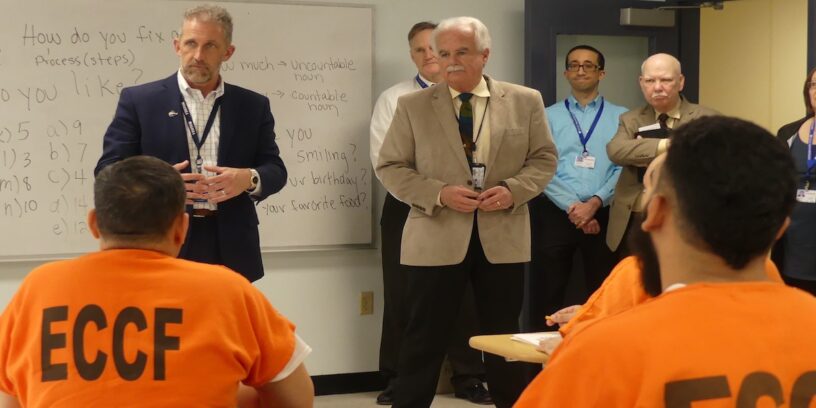



When it comes to reducing crime and providing those with criminal convictions an opportunity to improve their lives and become positive contributors in their communities, education matters.
How do we know?
At 13.5%, Essex County has the lowest one-year recidivism rate of all the counties in Massachusetts.
That is one of the reasons that a collaboration between Northern Essex Community College and the Essex County Sheriff’s Department was recognized this week by the Massachusetts Sheriffs’ Association with the 2026 Program of the Year award.

NECC and the Essex County Sheriff’s Department (ECSD) launched our partnership back in 2019, with a couple dozen incarcerated men at the Middleton Jail, providing English for Speakers of Other Languages (ESOL) classes, the opportunity to earn High School Equivalency diplomas, college writing courses, and preparation to transition back into the workforce after release.
Last year, the program grew to more than 1,300 people served, turning incarceration into an opportunity for rehabilitation and successful reentry.
The Middleton Jail now has a National Adult Education Honor Society and has even launched their own literary journal.
This is all a tremendous testament to the teachers, advisors and staff at NECC and the ECSD who devote their time and considerable talents to reaching and teaching some of our fellow citizens facing enormous challenges.
A few years ago, Sheriff Coppinger and I wrote about the importance of education programs like ours to the rehabilitation process, to criminal justice reform, and to making our communities safer and more economically vibrant.
We noted that:
The United States of America puts more of our citizens in jail than any other country on the planet.
While we have only 5% of the world’s total population, we have 25% of the world’s prisoner population. According to the World Prison Population List, an astonishing 716 of every 100,000 Americans are behind bars in local and county jails, state prisons, or federal penitentiaries.
To compound this challenge, imprisonment falls disproportionately on low-income and minority citizens. Though African Americans and Hispanics make up approximately 32% of the US
population, they are 56% of all incarcerated people in America.
While some kind of punishment is needed for an effective criminal justice system, the current approach to mass incarceration has proven too costly, and too ineffective, for everyone involved:
- The U.S. spends more than $80 billion each year on corrections, an amount that has increased at triple the rate of spending on Pre‐K‐12 public education over the past three decades.
- Recidivism — the rate at which those convicted of a crime and incarcerated commit another crime and return to prison — remains alarmingly high. A recent report from the U.S. Department of Justice indicates that more than 80% of state prisoners were arrested again at least once within nine years of their release.
- A criminal record can reduce the likelihood of a callback or job offer by nearly 50%; and this negative impact of a criminal record is twice as large for minority applicants.
With the passage of the Massachusetts Criminal Justice Reform Act in 2018, Massachusetts became the leader in a national effort to reduce rates of incarceration; including how juvenile offenders are treated in the criminal justice system, and how states can implement an array of services, such as education and employment counseling, behavioral therapy, substance abuse treatment, and domestic violence prevention to reduce the need for imprisonment.
As a result, according to an analysis by the Brennan Center for Justice, between 2007 and 2017, 34 states reduced both imprisonment and crime rates at the same time; and Massachusetts led the pack, with the steepest declines in both crime (40%) and incarceration (51%).
Massachusetts now has the lowest incarceration rate in the country.
Of all the ways proven to help reduce the likelihood that someone who has been in prison is going to commit another crime, the one that has the greatest impact for the lowest cost is quite clear: Education.
A national study of the effectiveness of correctional facility education programs by the Rand Corporation reveals that:
- Inmates who participate in correctional education programs are 43% less likely to re-offend than those who do not.
- The odds of finding a job after release for inmates who participate in correctional education is 13% higher than for those who do not.
- For every $1 spent on prison education, taxpayers save $5 on incarceration.
For all these reasons, the Essex County Sheriff’s Department and Northern Essex Community College are proud to provide educational and vocational skills for inmates in the Essex County Correctional Facility, the Jail and House of Correction in Middleton, the Essex County Pre-Release and Re-entry Center in Lawrence, the Women in Transition facility, and the three Community Corrections Centers in Lawrence, Lynn, and Salisbury.
A generation ago, many people approached criminal justice with a “Lock them up and throw away the key” mentality. Today, whether it is more humane treatments for inmates with opioid addiction, mental health treatment services, or education and training, we understand that our role is not simply to punish, it is also to prepare our “residents” for living productive lives when they reenter society.
Our most important job, and the most important job of every inmate, every correctional officer, and every college teacher and counselor in this program is ensuring that when each resident’s time is served, they walk out the door better than when they entered and are more prepared for a brighter future —and they don’t come back.

