




By Lane A. Glenn and Allison Dolan-Wilson
Note: An earlier version of this article appeared in CCDaily and in Commonwealth Magazine.
It may not always take money to make money, but it sure helps.
Last year, according to the Harvard Crimson, the Cambridge university’s famed endowment grew from $57 billion to nearly $68 billion, an astonishing 27% return on its investment, earning America’s oldest and most famous institution of higher education, with its nearly 7,000 undergraduate students, a whopping $11 billion.
According to its annual financial report, the University spent $2.6 billion from its endowment toward its total $6.6 billion operating expenses last year, preserving a healthy $8 billion or so of its annual profit for future rainy days.
Harvard’s undergraduates are about a quarter of their total enrollment (the Business, Law, and Medical Schools, along with other graduate programs, make up the rest), so rough math suggests that total expenditures per undergraduate student are around $282,000 a year.
Here at Northern Essex Community College, we have an undergraduate enrollment similar to Harvard’s, at just under 6,000 students. Our annual budget last year was $86 million, and our endowment (also boosted by a friendly stock market) grew to $11 million.
Our total expenses per student are around $14,000 a year.
We’re pretty much like the rest of the state’s public community colleges, which last year collectively spent around $1 billion on their 86,000 undergraduate students (about $12,000 per student).
The extra money Harvard’s endowment earned last year was more than ten times as much as all fifteen of the community colleges in Massachusetts combined spent.
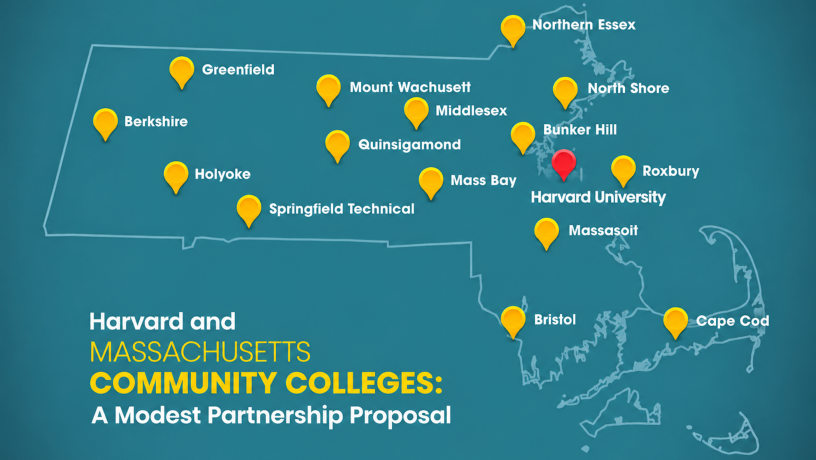
Here is a truly modest proposal:
Harvard should take $600 million of last year’s earnings (a fraction of the university’s annual “targeted payout range” for its endowment) and work with the state’s community colleges to create $40 million endowments at each one.
Then, to ensure its investment is truly meaningful, Harvard should partner with those fifteen community colleges to create direct, guaranteed transfer pathways for 200 of their students each year (a mere 10% of Harvard’s typical accepted freshman class).
Harvard should do this not out of charity, but because it’s the right thing to do, and a strategically smart move for arguably the world’s most strategically smart university.
Here’s why:
The Myth of the “Private” College
A few years ago, economist Richard Vedder wrote a provocative piece for Forbes, “There Are Really Almost No Truly Private Universities,” in which he catalogued the various ways that taxpayers provide enormous support for what we think of as “private” universities.
Pell grants, tax credits, and federally backed student loans, for example, all allow private universities to charge more for their tuition than an otherwise unsubsidized “free” market would actually allow.
Tax deductible donations provide needed capital for buildings (and growing large endowments), while state and local exemptions from property and sales taxes further reduce the cost of doing business, even for amazingly well-funded institutions.
How much are all these public subsidies worth to a university like Harvard?
It’s hard to say exactly, but an analysis by the Nexus Research and Policy Center examined the impact of per-student tax subsidies at a range of higher education institutions and discovered enormous differences ranging from $22 to $1 between elite private universities and local regional four-year campuses, to as much as $44 to $1 between those wealthier universities and local community colleges.
As an example, here in Massachusetts, Nexus estimated Massasoit Community College’s tax subsidy at $4,100 per student, and Harvard’s more than ten times higher at $48,000 per student.
In fairness to Harvard, the university has acknowledged some responsibility to contribute to their local communities and pays both Boston and Cambridge a few million dollars each year through voluntary PILOT (Payment in Lieu of Taxes) agreements with those cities.
However, the amount Harvard pays is a small fraction of what actual taxes would cost, and is regularly less than the cities request, leading the Massachusetts legislature to consider a bill that would require non-profit organizations like the Crimson that own at least $15 million in property to pay 25% of what they would have to pay if they were not exempt from taxes.
Of course, the Massachusetts legislature may be the least of Harvard’s worries.
During the first Trump administration, back in 2017, Congress levied a 1.4% excise tax on the net investment income of private colleges and universities with at least 500 tuition-paying students and endowment assets of at least $500,000 per full-time student.
For Harvard, that has meant around $50 million in new federal taxes each year since 2018.
Beginning in 2027, though, thanks to passage of the 2025 “One Big, Beautiful Bill,” which imposes a new tiered tax structure on private college endowments based on asset holdings per student at institutions with enrollments of at least 3,000, Harvard will owe up to 8% on its earnings, which is expected to cost the Crimson around $300 million a year.
As steep as that hike is, though, things could still get worse: That’s less than half of the 20% capital gains tax assessed on the nation’s wealthiest individuals, which, if ever applied to university endowments, could start running Harvard close to a billion dollars a year.
Even more disastrously, the Trump administration has been rooting around for reasons, such as “engaging in racial discrimination,” to completely end the non-profit status of colleges with admissions practices, scholarships or other support systems that benefit Black, Hispanic or other minority students, a move that would radically transform the finances of Harvard and many of the world’s other most prestigious institutions.
The Court of Public Opinion
Even though Harvard has been holding its own in federal courts against the Trump administration’s relentless attacks during the past two years, they have faced considerable challenges in the court of public opinion.
Americans’ decade-long decline of trust in higher education, chronicled in annual confidence surveys by the Gallup Organization, is largely a reflection of what gets reported most in the media: the soaring costs, increased student loan debt, campus protests, questions of free speech, and political polarization that are most evident at elite, private institutions like Harvard.
And ordinary Americans are unlikely to rise to the defense of a place that neither they, nor probably anyone they know, will ever be accepted.
Competition for undergraduate seats at Harvard and other “selective” universities is notoriously intense. When you have nearly 50,000 applicants and only admit 2,000, yet the applications keep coming, rejection is clearly not a flaw, it’s a selling point.
The elitism of Harvard and other Ivies is so notable, in fact, that Kalshi, the online prediction (gambling) market announced this week that they are planning to offer betting on how low the acceptance rates will go at twenty-two exclusive American universities.
To make matters worse, even after years of reportedly focusing on greater equity for talented low-income and minority students in admissions and going so far as losing a 2023 case in the Supreme Court over its admissions practices, not much has actually changed.
In a Washington Post story, “Harvard and Its Peers Should Be Embarrassed About How Few Students They Educate,” Jeffrey J. Selingo, the author of Who Gets in and Why: A Year Inside College Admissions, notes that, “Of the top 50 national universities in the U.S. News ranking, 16 are public and 35 are private (the numbers add to 51 because of a tie). At the public schools, an average of 26 percent of students receive Pell Grants. At the privates, the figure is just 15 percent.”
As a point of comparison, in a typical year, more than 50 percent of NECC’s students receive Pell grants, a rate similar to community colleges across Massachusetts and around the country.
So, the wealthiest universities are admitting far fewer low-income students than any other segment of higher education.
What about first-generation students and students of color?
It’s a mixed bag at best.
Nationally, over half the undergraduates on American college campuses are considered “first-generation”(neither parent completed a bachelor’s degree).
However, at Ivies like Brown, Princeton, and Yale, the proportion of first-gen students admitted last year ranged from 14%-21%.
Harvard actually rose near the top among the elites, boasting one of its lowest admittance rates ever, less than 4%, even as the proportion of admitted first-generation students held steady at 20% for the third year in a row and Pell Grant eligible students increased to 21%.
Harvard’s progress admitting first-generation and low-income students is important and deserves recognition, but they are still a very long way from reflecting the broader tapestry of America today.
And students of color?
That one is a bit tricky.
According to the Education Data Initiative, nearly half of undergraduates are students of color.
Until recently, when the second Trump administration turned statistics about race on college campuses into a tricky political minefield, elite universities like Princeton, Yale, Cornell, and Harvard took pride in noting the increased proportion of students of color they were admitting, particularly Black and Latino students.
However, while the numbers may be climbing, much like admissions of first-generation and low-income students, they are climbing very, very slowly.
In The Inequality Machine: How College Divides Us, Paul Tough notes that, while 15% of American high school students are black, only 8% of the students at Ivy League and other highly selective universities are Black.
And an increasing proportion of those admitted Black students, according to Tough, are from mixed-race families, immigrant families from Africa and the Caribbean, and international students who can afford to pay full tuition. Many have also attended prestigious prep schools like Phillips Academy in Andover which, while just down the street from NECC, may as well be on the far side of the moon for most of our students.
They are not, for the most part, low-income students from often struggling urban schools across America.
And this is just one of many reasons that, according to the Pell Institute’s annual “Indicators of Higher Education Equity in the United States” report, children of wealthy families are more than eight times likely to graduate from college (77%) than children from poor families (9%).
Despite their valiant efforts battling the Trump administration’s attacks on higher education, Harvard is not gaining a lot of ground in the court of public opinion.
A Mutually Beneficial Partnership
By partnering with the Commonwealth’s community colleges, which overwhelmingly enroll the largest proportion of first generation, low-income students of color in all of Massachusetts higher education, to build our endowments and create direct transfer pipelines, Harvard can help turn around its distressing record of enrolling underserved students—legally—and gain greater support from an appreciative public.
At a 5% annual payout, a $40 million endowment at each community college in Massachusetts will generate $2 million annually, which, if used like Harvard’s endowment, would boost operating budgets by more than 2%–more than nearly any annual increase in the fifteen years I have been president of Northern Essex Community College (and quite likely, more than most increases in our history).
And that relatively modest increase would be enough to boost financial aid for many students in need and hire more academic support staff to help more students graduate and, if they choose, transfer to other colleges and universities—like Harvard.
Through this partnership, Harvard will also be creating an admirable model for other elite institutions to follow.
The University of Pennsylvania, which boasts a $31 billion endowment that gained 28% last year, could partner with Pennsylvania’s 15 community colleges, which have been experiencing significant financial woesfor years, and offer some hope to their more than 200,000 students.
Princeton, with its more than $42 billion princely endowment (that earned a healthy 24% investment gain last year) could partner with the 19 community colleges in New Jersey and their 128,000 students.
And so on.
In the process, foundation directors, advancement professionals, and transfer advisors at community colleges could work closely with their counterparts at their state’s elite universities, learning, adapting, and expanding their networks; while significantly boosting opportunities for underserved students and helping those universities move from equity talk to equity walk.
We’re ready when you are, President Garber.
Let’s make this happen.

