



No one likes to be told to, “Do as I say, not as I do.”
Teenagers, parishioners, office workers and athletes all recognize immediately when parents, pastors, bosses or coaches don’t walk their talk.
College presidents can suss it out, too.
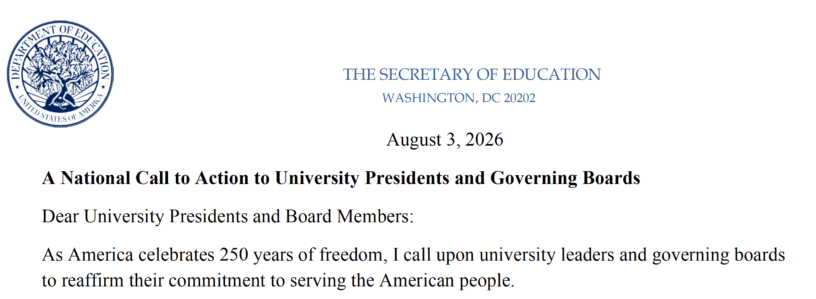
It’s no surprise, then, that higher ed leaders across the country are ruminating with raised eyebrows right now on a letter they received a few days ago from U.S. Secretary of Education Linda McMahon, scolding them for drifting from the principles that once made their institutions great and exhorting them to “reaffirm their commitment to serving the American people.”
Secretary McMahon’s letter, titled a “National Call to Action to University Presidents and Governing Boards,” notes that trust in higher education has fallen over the past several years, and cites the cost of college degrees, success rates of students, admissions practices, free-speech controversies and a roster of other complaints as culprits in Americans’ declining faith in their colleges and universities.
Fair point.
By now, any responsible higher education leader has spent at least some time reflecting on Americans’ widely reported eroding trust in what we do (according to Gallup’s most recent annual poll, just 38% of U.S. adults have high confidence in us, compared to 57% a decade ago).
Earlier this year, I recommended “Three Steps to Rebuild Trust in Higher Education in 2026.”
Soon after doing some of its own soul-searching last spring, Yale University published its “Report of the Committee on Trust in Higher Education,” and more recently, the American Association of Colleges and Universities unveiled its “Advancing Public Trust in Higher Education” initiative.
If the first step on the road to recovery is admitting you have a problem, higher ed is taking a long, hard look in the mirror.
But Secretary McMahon’s letter insists that we go farther and, by the end of this year, make public statements in response to seven prompts from the federal government about our integrity and effectiveness.
While the letter does not cite any specific punishments for institutions that fail to respond to the Department of Education’s “Call to Action,” or incentives for those that do, college presidents mulling it over can’t help but consider that leaders of this administration have declared that “universities are the enemy,” and followed through with tactics that feel like acts of war, like devastating economic sanctions, lawsuits, and targeting individual college presidents.
Secretary McMahon’s letter, with its seemingly more reasonable tone, arrived only after most of those attempts at punishing and controlling universities failed and were overturned in federal courts.
It’s shaky ground on which to build diplomatic rapprochement, and because of their previous treatment, college leaders understandably have to weigh how any kind of formal response might be used against them.
Just as challenging are the seeming conflicts between the administration’s words and its deeds.
Even as Secretary McMahon faults colleges for unacceptable student attrition rates and demands they take responsibility for ensuring better outcomes, the administration she represents has repeatedly attempted to eviscerate TRIO programs, funding for minority-serving institutions, adult basic education, and other federal aid that supports the students who need it most.
When she urges institutions to “encourage an ethic of free speech and foster a thriving marketplace of ideas, guided by open inquiry and honest debate,” no responsible college president can disagree; but it’s also difficult to reconcile that position with the same administration that has frozen grants to universities over ideological disagreements, targeted student protestors and used lawsuits and government agencies like the Department of Justice and Federal Communications Commission to silence or punish journalists, attorneys and political adversaries.
During the first eighteen months of the second Trump administration, reports Reuters, 75 rulings by federal judges have found that the government infringed on First Amendment rights, including freedoms of speech, religion and the press.
While the “Call to Action” rightly notes that “university-sponsored research can drive economic growth,” the administration has gutted federal funding for that research by tens of billions of dollars since last year; and when Secretary McMahon asks universities how to declare they will “protect academic programs from foreign influence,” it is difficult not to conjure images of the luxury jet the Middle East nation of Qatar gave the president (which he has indicated is destined for his library and personal use after he leaves office).
While it is true that trust in higher education has declined, for all these reasons and more, faith in the federal government has collapsed completely. A scant 17% of Americans believe that Washington will do what is right “most of the time,” and trust in Congress (9%), the Supreme Court (27%) and the Presidency (27%) are at all-time lows.
Striking a new accord with higher education is going to require a bigger mirror for self-reflection.
Of course, where you stand often depends on where you sit.
University presidents sitting on the campuses of highly selective, very expensive, private research institutions drawing sizable government grants may determine that the potential rewards for responding outweigh the risks. Indeed, for the most part, higher ed legal experts are encouraging at least some kind of broad reply to cover the bases.
At the same time, presidents sitting on community college campuses may simply acknowledge that for more than a century, they have been open access, admitting 100% of their applicants; quite reasonably priced (free in more than half the states, including Massachusetts); and solidly rooted in the civic life and workforce needs of their communities.
Regardless of how individual colleges and universities respond to Secretary McMahon’s “Call to Action,” one thing is abundantly clear: The decades-long, successful, symbiotic relationship between America’s federal government and its institutions of higher education that has built a system that, even with its faults, is the envy of the world, is heavily damaged, and not likely to fully recover during this administration.
The next president, from whichever political party, will face the monumental task of rebuilding shattered trust in her or his office, across the federal government more broadly and, hopefully in earnest collaboration with higher education leaders, in the nation’s colleges and universities.

