

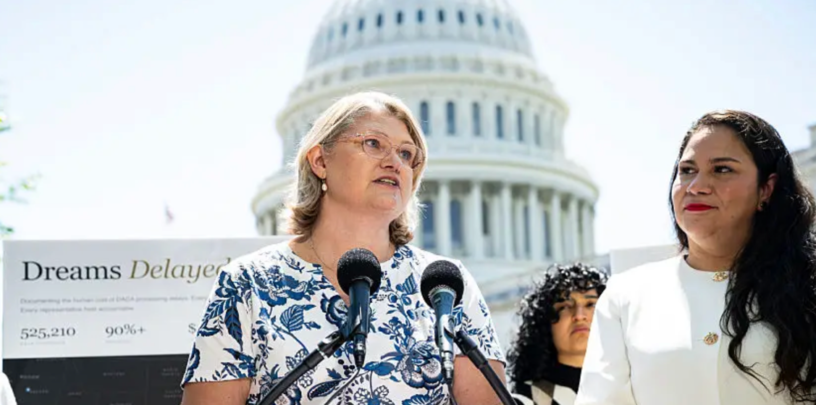



Jen Rickling never imagined she would become a voice in a growing immigrant human rights movement.
She supports President Trump and his efforts to control America’s borders and describes herself as a conservative resident of Southern Arizona where immigration issues have always been in the news.
But, as she explained at a press conference organized by TheDream.US that I attended outside the U.S. Capitol last week, “They really hadn’t hit home in a personal way until I watched my daughter-in-law, Annie, being taken away in handcuffs after accompanying my son and her husband, Matthew, to his military post.”
Rickling’s daughter-in-law, Annie Ramos, was born in Honduras and brought to the United States as a toddler in 2005. When she was seventeen, in 2020, she applied for status under the Deferred Action for Childhood Arrivals (DACA) program created by President Obama in 2012 to provide some protections to “Dreamers” like Annie, but her application, like approximately 80,000 others, is in legal limbo, stalled by a freeze on new DACA requests by a Fifth Circuit court decision that DACA is unconstitutional.
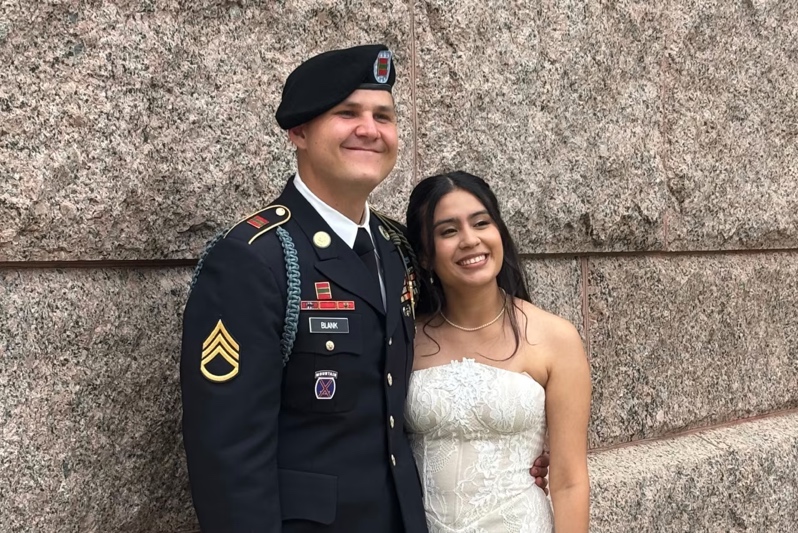
Meanwhile, Annie, who has only ever known life in the United States, is studying biochemistry at Arizona State University, teaches Sunday School, and married Rickling’s son, Matthew, a staff sergeant in the United States Army.
But for the Trump administration’s no-holds-barred crackdown on immigration, that’s not enough, so Annie, like hundreds of other DACA registrants over the past year, was arrested.
Although she has since been released, as Rickling explains, “Annie and Matthew’s future together remains uncertain. For Annie and other Dreamers like her, there has to be a better way than detention and deportation.”
Indeed, there does.
Illinois Senator Dick Durbin, who also spoke at last week’s event, has introduced versions of the DREAM (Development, Relief, and Education for Alien Minors) Act in every session of Congress since 2001.
The DREAM Act, which would provide certain “Dreamers” (people without legal citizenship status brought to the United States as young children) protection from deportation, access to education and employment, and an eventual pathway to lawful permanent residence, has had bipartisan support, and at different times earned a majority of votes in both the House of Representatives and the Senate, but not the 60 votes needed to overcome a Republican Senate filibuster.
So, for twenty-five years the bill has perched just on the edge of passage even though, as a 2025 Gallup Poll reflects, 85% of Americans support allowing Dreamers to obtain citizenship if they meet certain requirements.
Notably, the same poll showed that a record high 79% of U.S. adults say that immigration is a good thing for our country.
It is past time for Congress to listen to the majority of Americans who recognize that we are a nation of immigrants, founded on the potential of building new lives in new lands, and who know that we especially need educated young people for our current and future workforce.
It is time for Congress to pass the bipartisan DREAM Act.
I was invited to speak at last week’s press conference, following Jen Rickling and Senator Durbin, as a representative of the more than 600 college and university leaders who are members of The Presidents’ Alliance on Higher Education and Immigration, and this was my appeal to our legislators:
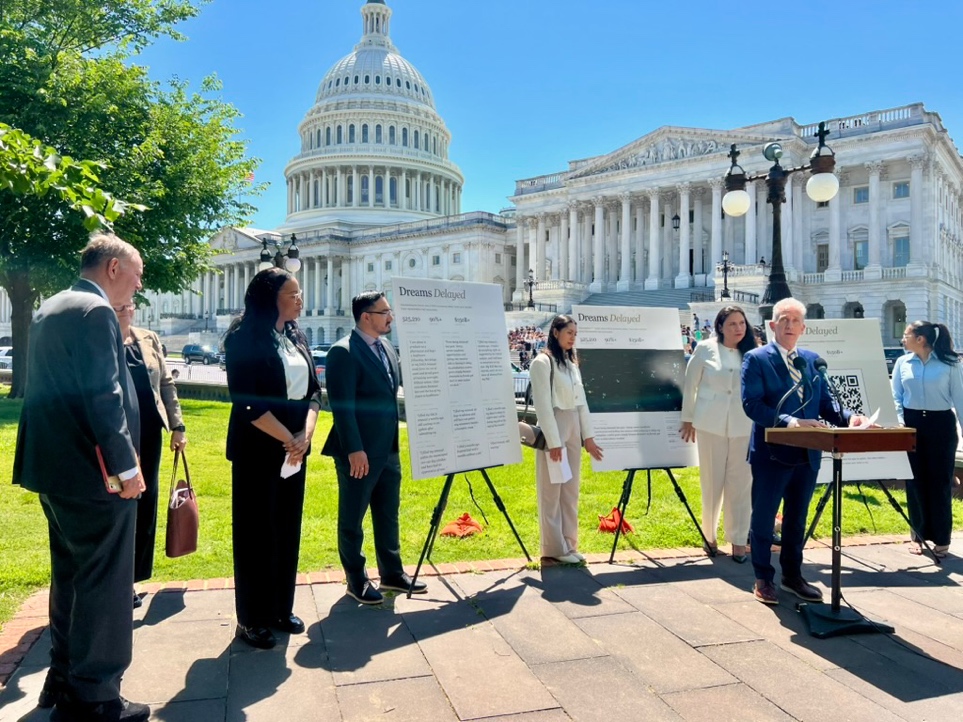
My name is Lane Glenn. I am the president of Northern Essex Community College, and a member of the Presidents’ Alliance on Higher Education and Immigration, a nonpartisan group of nearly 600 college and university presidents across the country who know that immigrants, including Dreamers, are an essential part of the life of our campuses today, and central to the future of higher education and to our country’s economic vitality tomorrow.
As New England’s first federally recognized Hispanic Serving Institution, Northern Essex serves the largest proportion of Hispanic students, more than half, of any college or university in Massachusetts. Today, most of those students are from the Dominican Republic, Puerto Rico, and countries in Central and South America.
One of our two campuses is in the City of Lawrence, nicknamed the “Immigrant City,” because it was founded in the 19th century as a home for immigrant labor in the industrial mills along the Merrimack River, and has been occupied by wave after wave of immigrants from around the world ever since.
For nearly two centuries, those immigrants, Irish, Polish, Lebanese, Italian and now Dominican, have helped build American prosperity.
And for more than half a century, they have been taking classes and earning degrees at Northern Essex, where we are proud to educate Dreamers who arrived in America as children, grew up in the cities and towns of the Merrimack Valley—the only home many of them have ever known—and are part of the more than 500,000 Dreamers enrolled in colleges and universities across the United States.
Dreamers like Rosa, who secured her DACA status and studied Criminal Justice at Northern Essex before going to work as a 911 dispatch operator. She now lives in uncertainty, not knowing if her DACA status will be renewed or if a court case will turn against her and other Dreamers and send her to a country she barely remembers.
Her real fear, though, is for her younger brother, Rafael, who applied for his own DACA status, but whose application was halted by the Fifth Circuit Court decision that has frozen all new applications for the last five years.
While Rosa has temporary protection and work status, her younger brother, with the same life experience from the same household, who is a brilliant student studying accounting with ambitions to open his own small business, is even more vulnerable—and afraid.
Besides contributing to the learning communities on our campuses as students, Dreamers are also an essential part of the higher education workforce. Many go on to become teachers, researchers, staff members, and campus and community leaders.
Meanwhile, our alumni drive innovation in Massachusetts and beyond. They start businesses, employ their neighbors, and contribute to the economy through taxes and spending.
In Massachusetts, as in much of the northeast, immigration has been driving our population growth, and it is absolutely essential to our workforce: a recent study estimated that, if nothing changes, our state will be nearly 200,000 college educated adults short of the workforce we need in 2030.
When Dreamers are pushed out of opportunity, our colleges, employers, and local economies all lose talent we cannot afford to lose.
The threats facing Dreamers with and without DACA are real. I see the growing fear and uncertainty on our campus, fueled by DACA processing delays and rising concerns about detention and deportation.
We know even greater threats lie ahead if we don’t make a change. We stand to lose a generation of talent. We also stand to lose what makes our country and our colleges great: a commitment to bringing people together to advance knowledge, make new discoveries, and build toward the future.
The United States is a nation of immigrants.
Our colleges, communities, and economy all need Dreamers to succeed.
Our students should not have to keep living from court decision to court decision or policy change to policy change.
From our campuses, the message is simple: We need stability and a path forward so students can learn without fear, researchers can pursue their innovative ideas, and our academic communities can thrive.
Congress has the opportunity to provide permanent protections through bipartisan solutions that a majority of Americans have supported for years, like the Dream Act and the American Dream and Promise Act.
We owe it to our students, and we owe it to our nation.
NOTE: To learn more about the human, social, and economic costs of DACA processing delays, visit the new “Dreams Delayed” web site created by TheDream.US, and for access to a wide range of resources on higher education immigration policies, litigation and resources for students, including the “Legal Pathways That Work Resource Hub,” for tools and strategies for post-graduation employment, visit the The Presidents’ Alliance on Higher Education and Immigration.

