





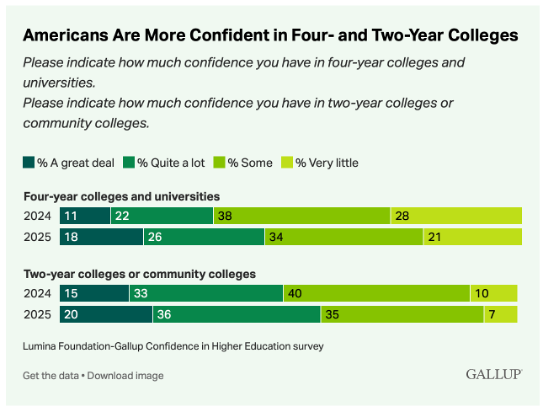
During a particularly tumultuous year for American higher education, a glimmer of good news peaked through the storm clouds in 2025: According to the Lumina Foundation-Gallup Confidence in Higher Education Survey, Americans’ trust in its colleges and universities slightly rebounded to 42% from its historic low of only 36% the year before.
That may be cold comfort to institutions experiencing billions of dollars in reductions from federal grants; sudden, major shifts in research priorities; and a plethora of policy changes and legal actions striking at institutional autonomy, admissions and hiring practices, curriculum and classroom teaching and, of course, DEI.
At least it’s a start.
Still, more than half of Americans have little to no confidence that colleges and universities, including some of the most famous in the world right here in Massachusetts, are faithfully fulfilling missions that serve the country well.
If higher ed leaders are to turn this trend around, the road to redemption will be long and challenging, but if every journey begins with a single step, here are a few that we should strongly consider taking, willingly and as soon as possible, to rebuild that lost trust.
1. Recognize that we have a problem.
In The Speed of Trust, Stephen M.R. Covey describes the foundations of trusting relationships, behaviors of high trust leaders and, importantly, how to rebuild trust once it has been lost. To begin with, Covey, recommends, don’t deny, ignore, or evade the problem: “Confront the reality.”
So, in reality, why is trust in higher education deteriorating?
As recently as a decade ago, in 2015, nearly 60% of Americans expressed “A Great Deal” or “Quite a Lot” of confidence in higher education.
Now, according to another poll from the Pew Research Center, 70% of Americans say higher ed is going in the “wrong direction.”
Today’s crisis of confidence in higher education is part of a national growing distrust in all institutions: According to Gallup polling data, Americans have even less faith in Congress, the Presidency, the Supreme Court, banks, public schools, and organized religion than they do in higher ed.
But their skepticism about higher education has been brewing for decades, and its causes are well known.
Critics across the political spectrum, from William F. Buckley Jr., Allan Bloom, and Richard Bernstein to John McWhorter, Greg Lukianoff and Jonathan Haidt have faulted colleges and universities for enforcing ideological conformity and becoming increasingly hostile to divergent points of view.
Add the soaring cost of higher education and mounting student debt over the past twenty years, reports of campuses that are hotbeds of identity politics and educators’ responses to the Covid-19 pandemic, and even supporters of higher education have been turning into skeptics.
Any higher ed leader not prepared to confront the reality of this accumulation of lost trust will find it challenging to take the next two critical steps.
2. Take responsibility.
In Mistakes Were Made (But Not by Me), Carol Tavris and Elliot Aronson explain how cognitive dissonance—that discomfort we feel when our actions conflict with our self-image—cause people and institutions to deny errors, rewrite reality, and double down on mistakes, all in an attempt to justify behavior that, deep down inside, we know is wrong.
Hard as it may be to climb over this monumental mountain of human nature, the next essential step for higher ed leaders to take after recognizing that we have a problem is taking responsibility, where appropriate, for our part in it, so that we can improve, instead of doubling down on past mistakes.
If you are a seasoned college leader, or if your general counsel is reading this alongside you, then you are probably already forming your objection to this step.
It’s true: Publicly admitting to specific, illegal actions can have adverse consequences for institutions and their leaders.
In 2020, Princeton University President Christopher Eisgruber faced an Office of Civil Rights (OCR) investigation by the first Trump administration when he publicly apologized for being “a university that, for most of its history, intentionally and systematically excluded people of color, women, Jews, and other minorities,” but that now “takes pride in the diversity of our community.”
From that episode, though, comes at least one strategy for how higher ed may be able to more safely take responsibility for mistakes, where appropriate.
The American Council on Education (ACE), along with 55 other national higher education groups, sent a letter to U.S. Department of Education Secretary Betsy DeVos, urging her to “end this misguided effort and not use the power of the federal government to investigate schools that are trying to build a better, more inclusive America.”
In the waning days of the first Trump administration, OCR took no action on the investigation, and in February 2021, dropped it entirely, citing insufficient grounds to proceed with enforcement actions.
ACE, the American Association of Community Colleges, American Association of State Colleges and Universities, Council of Independent Colleges, and dozens of other national organizations representing the full array of higher education institutions frequently speak on behalf of their members, and they can play an important role in acknowledging some of the missteps of the past decade or two that have led to decreasing confidence in higher education, without citing specific transgressions or throwing particular institutions under the bus.
Thankfully, this is beginning to happen.
At their recent annual meeting, on a panel titled “Truth, Trust, and Leadership: Higher Education’s Inflection Point,” even as he staunchly defended the value of higher education, ACE President Ted Mitchell acknowledged, “Free speech is under threat. It’s under threat from the right, and it’s under threat from the left. We need to improve tolerance and viewpoint diversity on our campuses. Let me just say—cancel culture is wrong, whether it comes from the left or the right.”
With clear, consistent, and frequent messaging like this, through a variety of channels, associations can help shift the narrative by naming what may have gone wrong, like suppression of free speech and ideas, bias in hiring processes, mishandling of student protests, excessive cost increases, lagging graduation rates, and low job placement, so institutions can proceed with making it right.
Whether national associations play this role or institutional leaders themselves, there is a playbook recommended by crisis management experts that, followed carefully, can provide an avenue for meaningfully expressing regret while minimizing legal liability.
Crisis experts recommend apologizing by centering empathy, acknowledging impact, taking responsibility for response and repair, and committing to corrective action—while avoiding statements that accept specific legal fault.
Engaging your college’s (or association’s) communications team and legal counsel in developing a strategy for what you will be acknowledging may be helpful, along with knowing whether your state is one of nearly forty across the country that have some form of “apology law” that may allow for statements of sympathy or regret that do not increase legal exposure.
3. Make and keep new commitments
As Covey notes in The Speed of Trust, “Nothing rebuilds trust faster than performance.”
After you’ve recognized the problem and taken responsibility for it, the final, and perhaps most crucial, step is to make and keep new commitments that matter, in this case to students, families, policy makers, taxpayers, and other stakeholders in higher education.
Regaining confidence means walking the talk and letting actions, not words, do the work.
So, what should colleges and universities commit to?
Based on the reasons we have been given for eroding trust in higher education, some likely candidates for commitments that will matter to stakeholders, depending on the institution, include pursuing truth in research and teaching unblinded by ideology; creating campus environments that are truly open to diverse points of view; curbing grade inflation; purging all forms of bias in hiring processes; reducing the cost of attendance; improving graduation rates; and ensuring coursework and degrees are preparing students for the real world of work after graduation.
If that last option makes you fretful about “careerism” in higher education and you’re still hung up debating the merits of “education vs. training,” it’s time to move on.
According to a 2023 Gates Foundation survey, the number one, two, three and four reasons students come to our campuses are all about getting the training needed for a better, higher paying job with more security.
The new Carnegie Classification of Institutions of Higher Education reflects the importance of post-graduation earnings for every college and university, and if you want some inspiration with your pragmatism, dig into Achieving the Dream’s new Community Vibrancy framework. While it’s designed for community colleges, its principles and tools can work for any higher education institution, and since right now Americans place significantly more confidence in two-year institutions than four-year institutions, it may be a great place to start.
For nearly a century, American higher education has been considered the best in the world for our ability to innovate and invent, to attract and create top talent, to open affordable doors of opportunity for all, and to attract enormous public and private investment in our work.
The social compact, based on mutual trust, that built our world-class system has been fractured. It’s going to take intention, action, and time to rebuild, and that journey begins with these three important steps.

