





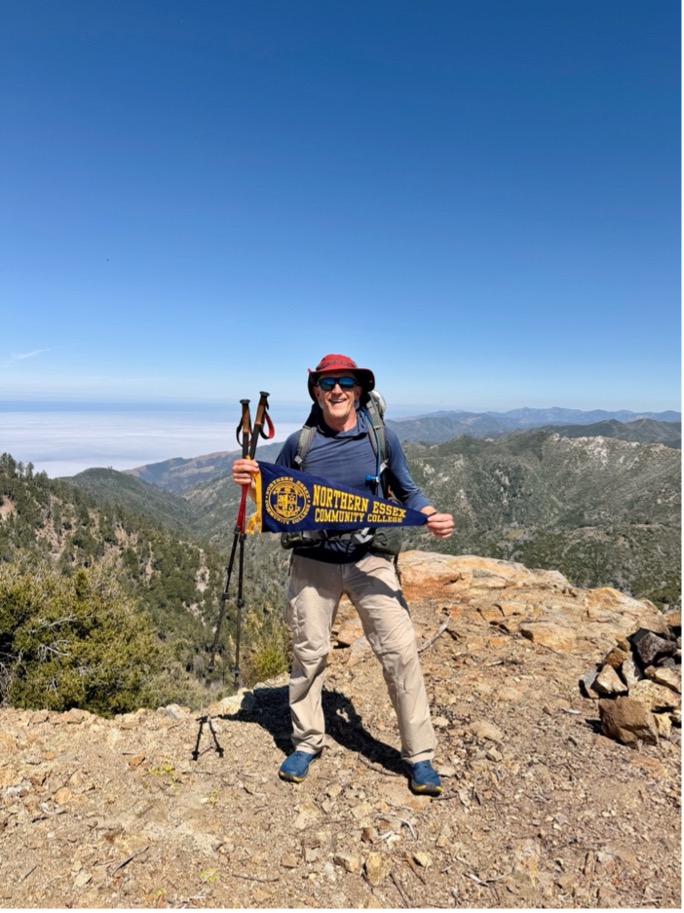
3 brothers
5 days
60 miles
10,000 feet of ascent
Lots of 200’ tall redwood trees
2 beautiful camp sites on scenic rivers
1 rattlesnake
0 emails
1 college pennant on top of the highest coastal peak in the lower 48
Go, Northern Essex Knights!
Finding Your Work-Life Balance Optimization
Years ago, at a time in my life when I needed to hear it the most, a leader I respect set me straight about “work-life balance.”
“You’re not after work-life balance,” he admonished, after hearing me complain about my lack of it at the time, “What you’re after is work-life optimization. Or, better still, just life optimization.”
There, in that moment, it clicked for me.
I was in my early thirties, with two young children, building my own leadership career, fixing up my first house, and gaining skills as a competitive runner and adventure athlete.
It’s a stage of life when many people struggle to make time work the way they want it to work; when so many things, like sleepless babies, demanding work schedules, and leaky roofs are out of our control, stacking frustration on top of what feels like futility.
We all have the same twenty-four hours in a day, and I couldn’t create more of them.
But it wasn’t a temporal shift I needed, it was a between-the-temples one.
The way I thought about the time I spent on various tasks was as important as the tasks themselves and the amount of time I spent on them.
Work-life balance means striving to devote roughly equal time (i.e., “balance”) to the things we call work and the things we call life. It requires strict boundaries, like closing your laptop at 5:00 p.m. during the week and not opening it on weekends. It views work as something necessary that must be limited or contained.
Whole systems have been developed for doing this, like the “8-8-8 Rule,” which advises you to divide each day into eight hours of work, eight hours of sleep, and eight hours of leisure time.
It’s an admirable aim, and for anyone struggling with severe work-life imbalance (like a “workaholic” neglecting personal health and family relationships or someone with an unreasonably demanding job) may be a helpful framework for creating some equilibrium.
But it can also be a recipe for constant frustration, since actual “balance,” for most people, is not a reasonable expectation. After all, stuff happens, to all of us, practically every day.
So, Monday may find you getting up an hour early for a doctor’s appointment before work and leaving in the afternoon to chaperone your daughter’s middle school ski club, working a short five hour day; while Tuesday and Wednesday, you’re eating takeout at your desk while working overtime on a project deadline.
And so on.
With a work-life balance mindset, each of those days is problematic and breeds resentment, as life intrudes on work and work intrudes on life.
A work-life optimization mindset treats it all differently.
Instead of creating rigid boundaries between life and work, as if they were mortal enemies warring for your time, optimization seeks to integrate the two in whatever way provides you with the greatest amount of energy and fulfillment (while still accomplishing necessary tasks).
It’s less about when you work and more about how you work and live.
Some of us are early risers who do our best thinking, planning, and communicating before dawn when the rest of the world is asleep, while others are night owls who may start the day slowly but hit their stride in the afternoon and really start jamming after 8:00 p.m.
Some of us have brains that enjoy multitasking and operate best in busy environments with lots of stimulation, while others prefer quiet places where they can focus on one task at a time.
Some of us are natural risk-takers, excited to push our boundaries toward new projects and opportunities, while others are comfortable with the tried-and-true and a measure of job security.
During different stages of life, you may need to be more attentive to an important new relationship, child (or elder) care, career building, home renovations, health concerns, and a myriad of other challenges and opportunities.
A work-life optimization mindset offers the flexibility you need to tune your environment to your personal strengths and preferences while adjusting how you spend your time to the constantly changing rhythms of your life.
How do you optimize?
For me, it meant starting with some self-reflection, and asking questions like:
What gives me energy?
When am I at my best?
What are my strengths?
What kind of environment fuels me?
The answers that I came up with are unique to me, and what works for me may not work for you. We’re all different, so work-life optimization looks different for each of us.
Some ideas that may work well for everyone include:
Listen to Your Voice of Vocation
There is a lot of truth to the adage, “Do what you love, and you’ll never work a day in your life.”
However effective you are at balancing or optimizing your life, you will spend a significant amount of it working. Ideally, you find or create a job that you love that allows you to play to your strengths and optimize your energy.
In Let Your Life Speak: Listening for the Voice of Vocation, Parker Palmer advises, “Before you tell your life what you intend to do with it, listen for what it intends to do with you. Before you tell your life what truths and values you have decided to live up to, let your life tell you what truths you embody, what values you represent.”
I love my job. I enjoy the field of education and the challenges and rewards of leadership, and every day I’m surrounded by talented, striving students and colleagues in an environment that energizes me.
And if I weren’t a college president, I might be a carpenter, because I also love designing plans and using my hands, tools, and raw materials to create things that people will use and enjoy for years to come.
Hearing your own “voice of vocation” can happen at any age. If what you do now doesn’t feel aligned with the truths you embody and the values you represent, seek a change. Work-life optimization begins with doing what you love.
Sharpen the Saw
As Stephen Covey famously recommended in The 7 Habits of Highly Effective People, don’t forget to “Sharpen the Saw.”
Dull tools are not as effective as sharp ones, and the same goes for people. Prioritize the things that nourish your body, your mind, your heart and your spirit, whatever they are, knowing that it is time well spent, because when you are sharp you will show up more effective at work and in life.
Around my house we have a saying, “A tired dog is a good dog.” While it originally referred to Sparty, our Airedale terrier, my wife and daughters long ago started using it to describe me. Like Sparty, I have a lot of energy, and I focus and work better when some of it is exhausted.
So, I exercise nearly every morning before work. Years ago, I also started the President’s Running Club at NECC (our motto: “We run the campus!”) to give me an excuse to slip out of the office at lunchtime and burn off some energy running laps around the campus.
Whenever I can, I trek up into the mountains of New Hampshire to go peak bagging or drop my kayak in the Merrimack River to race the tide. And once in a while my brothers and I will put together something bigger and more challenging, like the Triple Crown of Canmore in the Canadian Rockies, summitting Mount Kilimanjaro, or our recent “sea to summit” expedition from the California coast through the redwood forest of Big Sur to the top of Cone Peak, the highest coastal mountaintop in the lower 48 states.
As a leader, taking a few laps around campus at lunchtime or unplugging for a week or two to go roam some mountains also lets everyone around me know how important I think it is for them to make time for whatever rejuvenates them, too.
Know what sharpens your own saw, and make sure to prioritize it.
Be One with Everything
One of my favorite, often repeated, dad jokes goes like this:
What did the Zen master say to the hot dog vendor?
Make me one with everything.
Sometimes, there is great wisdom in eye-rolling humor.
While work-life balance seeks to compartmentalize labor and pursuits of pleasure, as if you were an employee of Lumon Industries in Severance whose memories and personality had been surgically divided, an optimization mindset embraces work and life as part of a single, fluid, integrated ecosystem.
The goal is to find a comfortable way to be “one with everything.”
This will also mean different things for different people in different jobs at different stages of life.
Some may bristle at the notion of letting your job define your identity. I understand, and certainly don’t walk into every room wearing my “college president” hat. If that’s a bridge too far for you, OK, but consider other ways you can integrate who you are with what you do.
I do walk into every room with my “educator” hat on, because I can’t take it off. It’s a core part of my being and how I experience the world, along with my “writer”, “runner”, “optimist”, “husband”, “father” and “pun lover” hats.
Unlike the cast of characters in Severance, we bring our whole selves to work each day, and we take our whole selves home again.
It can be healthy and liberating to let those selves flow together.
In addition to how you think about integrating your work-life identity and the hats you wear, when it comes to time it may be helpful, instead of thinking about daily work-life balance, to think about seasonal work-life optimization.
Whatever job you do and whatever personal responsibilities, goals, or hobbies you have, know that the time you spend on them will vary over the course of weeks or months, offering you greater day-to-day mental flexibility and grace.
Around my house, we know there are “peak” periods of work activity when my focus is largely on my job.
The “new year” at a college is early September when students and faculty return to campus, classes resume, and meetings start to fill the calendar again. November and April for a college president are often busy months for chamber of commerce dinners and community events. May brings end-of-year dinners, celebrations, induction ceremonies and, of course, everyone’s favorite occasion: graduation.
During those peak times, it is quite common for me to be out at events almost nightly and to be responding to a steady stream of emails into the evenings and on the weekends. That’s just how it is.
In between, there are stretches of still active but less busy times, like July and August, or the end of December and beginning of January, times when my wife and I can do home improvement projects, take the kayaks for a leisurely paddle, or escape to the Canadian provinces for skiing or sightseeing; and my brothers and I can go backcountry adventuring for a couple of weeks at a time.
Over time, I’ve learned some strategies that help manage the flow of all this and, just as importantly, help others understand how I work and how we can work best together, with all our many hats on.
For example, I get a lot of email, and if I’m not careful, reading and responding to it could consume most of my time. So, a couple of times a year, I send the people I work most closely with an email about email, asking for their help with effective electronic communication.
Beyond the basics, like minimizing “replies to all” and considering whether an email is necessary in the first place, I ask emailers to include “RESPONSE REQUESTED” in subject lines of messages that need a reply. I’m also clear that it may take me 3 or more business days to review and respond to a normal email, so if something requires a more rapid reply they should try a phone call, text, or in-person conversation. And I encourage others to apply similar rules that work well for them.
Although I find myself catching up on emails early in the morning, in free weekend moments, or, best of all, during long plane rides in the middle of the night, I don’t presume that those are times that others will be responding, so I use timers to delay sending messages until normal business hours.
In my role, I am fortunate to be able to hire and develop leaders around me and to rely on one another for support. A few years ago, one of my brothers, a COO for a biotech company, introduced me to the “Helpful Hierarchy” model of workplace responsibility that encourages independent initiative and decision-making.
While originally created to describe ideal dynamics between bosses and their employees, we’ve adapted it to think not only about how we encourage those we lead to analyze, make decisions and take action themselves; but also how we show up for each other and support one another.
You don’t have to be the boss to apply the ideas of the “Helpful Hierarchy.” Any group of willing, supportive co-workers can take them and run with them, creating an environment of trust and mutual support that allows for a wide range of personal strengths and preferences and accommodates both the personal and the professional.
Because it’s a lot easier to “be one with everything” when you’re not going it alone, when you’re part of a team that is also bringing their whole, optimized selves to work and striving to “be one with everything” too.

