





Neil Sedaka died on Friday.
While the 86-year-old singer-songwriter was mostly known for early 1960s bouncy teen pop hits like “Calendar Girl” and “Breaking Up is Hard to Do,” and later in his career for Yacht Rock favorites like “Laughter in the Rain” and “Love Will Keep Us Together,” he also penned one of the most poignant, newly relevant songs about America’s long-running, deeply conflicted, love-hate relationship with immigration.
“The Immigrant,” recorded in 1975 and inspired by the experience of his father, a Jewish immigrant from Russia, and millions of others who made the journey, begins by extolling the welcoming embrace of travelers from other lands during America’s early decades:
Harbors opened their arms to the young searching foreigner
Come to live in the light of the beacon of liberty
Planes and open skies, billboards would advertise
Was it anything like that when you arrived
From our nation’s founding and for most of its first century of existence, actual citizenship was restricted to male, “free white persons” by the 1790 Naturalization Act; though otherwise, our borders were quite open, encouraging new arrivals to help populate the country and supply labor for industrialization and westward expansion.
Dreamboats carry the future to the heart of America
People were waiting in line for a place by the river
It was a time when strangers were welcome here
Music would play, they tell me the days were sweet and clear
It was a sweeter tune and there was so much room that people could come from everywhere
The Statue of Liberty was first envisioned in 1865 as a gift from the people of France meant to commemorate the historical friendship between the two countries and the centennial of U.S. independence in 1876.
Now he arrives with his hopes and his heart set on miracles
Come to marry his fortune with a hand full of promises
To find they’ve closed the door, they don’t want him anymore
Isn’t anymore to go around
But by the time of its delayed opening in 1886, the federal government had created its first immigration regulations and popular sentiment was turning against foreigners, particularly non-Europeans: The 1882 Chinese Exclusion Act was the first law passed specifically to restrict immigrants from entering the country.
Emma Lazarus’ famous poem, “The New Colossus,” emblazoned on the statue’s pedestal immediately began to feel more aspirational than real:
Give me your tired, your poor,
Your huddled masses yearning to breathe free,
The wretched refuse of your teeming shore.
Send these, the homeless, tempest-tost to me,
I lift my lamp beside the golden door!
The rest of “The Immigrant” is a lament and a cautionary tale about what happens when the “beacon of liberty” turns its back on the world:
Turning away he remembers he once heardA legend that spoke of a mystical magical land called America
There was a time when strangers were welcome here
Music would play, they tell me the days were sweet and clear
It was a sweeter tune and there was so much room that people could come from everywhere
Looking back from 2026, this semiquincentennial year of our nation’s founding, the last hundred-and-fifty years have watched the pendulum of American immigration policy swing back and forth between restriction (often connected to economic anxiety, war, or cultural fears) and openness (usually tied to labor needs or humanitarian ideals).
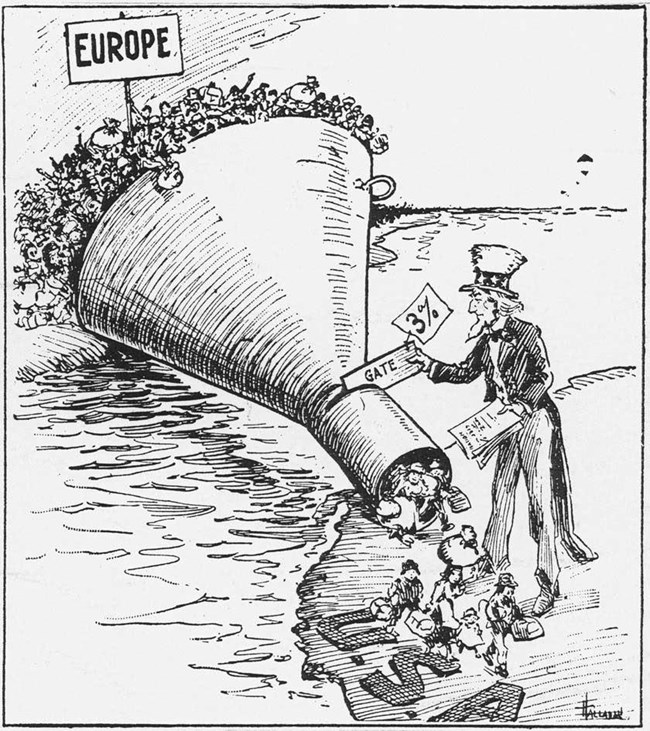
The Emergency Quota Act of 1921 and Immigration Act of 1924 imposed strict national quotas favoring northern Europeans and practically eliminating Asian immigration.
Decades later, the Immigration and Nationality Act of 1965 ended those national origin quotas, prioritized family reunification and skilled workers, and significantly increased immigration from Asian and Latin American countries; and, in the aftermath of the Vietnam War, the Refugee Act of 1980 (which, perhaps unbelievably given today’s polarized Congress, passed unanimously in the Senate) created a formal system for admitting larger numbers of refugees who faced “a well-founded fear of persecution” in their home lands.
Most recently, across two very different presidential administrations, the pendulum has swung wildly between reduced refugee admission, barriers to international students, increased border security and deportation enforcement, and bans on specific nationalities; to expanded refugee access, welcoming international scholars and reduced enforcement policies; and now, back again.
There was a time when strangers were welcome here
Music would play, they tell me the days were sweet and clear
We are all immigrants in one way or another, and beyond Neil Sedaka, American popular culture is filled with stories of how we treat, and often mistreat, those arriving after we did, from Californians rejecting the “Okies” fleeing the Dust Bowl and seeking work out west during the Great Depression of John Steinbeck’s The Grapes of Wrath to the Oscar nominated In America, about a family of undocumented Irish immigrants barely scraping by in a shabby New York tenement in the early 1980s, surrounded by refugees from all around the globe.
There is more, though, than just rejection and suffering faced by immigrants in these and other books, movies and songs. The strongest, most common theme is pride in their national identity, coupled with yearning for the promise of America, where that identity can exist freely.
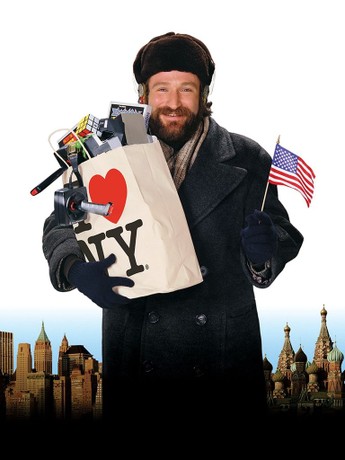
From Robin Williams as Soviet circus musician Vladamir Ivanov in Moscow on the Hudson defecting to the United States during the Cold War proclaiming, “This Is A Free Country, Welcome To Almost Anyone. Yes, In America Almost Anything Is Possible,” to Ming-Na Wen as Jing-Me (June) Wu in The Joy Luck Club reflecting with the ladies at the mah jong table that, “My mother believed you could be anything you wanted to be in America,” there is a resiliency, jubilant spirit, and love for America among those who struggled to reach our shores.
There was a time when strangers were welcome hereMusic would play, they tell me the days were sweet and clear
If history is a guide, and I am fervently hoping that it is, our current period of restrictionist policies and sometimes xenophobic anger and mistreatment of others will be quickly followed by the pendulum again swinging toward greater openness and compassion for our global community.
Every country, including the United States, needs to ensure its safety and security, to manage its resources, and promote its values—goals we can accomplish while still treating everyone with dignity, fairness and humanity, and ensuring that immigration, the lifeblood that has fueled our nation’s success since its inception, remains strong.

