



At Northern Essex Community College, and at thousands of other colleges around the country, many students and their families are living in fear right now.
As New England’s first federally recognized Hispanic Serving Institution, Northern Essex serves the largest proportion of Hispanic students, just under 50%, of any college or university in Massachusetts. Today, most of those students are from the Dominican Republic, Puerto Rico, and countries in Central and South America.
One of our two campuses is in the City of Lawrence, nicknamed the “Immigrant City,” because it was founded in the 19th century as a home for immigrant labor in the industrial mills along the Merrimack River, and has been occupied by wave after wave of immigrants from around the world ever since.
For nearly two centuries, those immigrants have helped build American prosperity.
The overwhelming majority of our students are United States citizens; some are Lawful Permanent Residents (a.k.a. Green Card holders); some are temporary Non-Immigrant Visa holders, either for work or for education; some are refugees with Temporary Protected Status; a small number are undocumented immigrants; and many live in mixed status families.
Regardless of their citizenship status, though, faced with a federal government openly hostile to anyone who looks or sounds “foreign,” they are rightfully worried.
Since last September, when the Supreme Court cleared the way for racial profiling by ICE agents, the color of someone’s skin and whether they speak Spanish or English with a Spanish accent are all factors that may lead to an arrest and detention, or to much worse: In addition to the recent shooting deaths of Renee Good and Alex Pretti at the hands of ICE agents in Minneapolis, 32 people died in ICE custody in 2025, making it the deadliest year for the agency in more than two decades.
While the administration has claimed their crackdown on illegal immigration is aimed at the “worst of the worst,” the reality is quite different. As an analysis by the Cato Institute reveals, nearly 75% of people booked into ICE custody since October have no criminal record, and about half do not even have criminal charges pending.
Only 5% actually have violent criminal records.
So, while the president holds up wanted posters of criminals captured by ICE at press conferences to give the impression that the agency is only nabbing the bad guys; the overwhelming number of people arrested or detained by ICE are actually parents, grandparents, and children. They are dishwashers, restaurant servers, and teenagers like Marcelo Gomes da Silva, a Massachusetts High School student on an expired visa who was arrested and jailed on his way to volleyball practice.
Arrests like Gomes da Silva’s, deaths like Good’s and Pretti’s, and widely publicized ICE surges in communities like Minneapolis, Chicago and Portland, Maine (where the operation was dubbed, in juvenile, dehumanizing fashion, “Catch of the Day”) are having their intended impact: Word is out in communities like Lawrence, where small businesses are struggling, children are staying home from school and showing signs of mental health distress, some parents aren’t working, elderly relatives are skipping doctor’s appointments, and church pews are emptying.
This is not normal and it is not right.
There are signs that this terrible tide may be turning:
In Congress, Senate Democrats reached a deal with the White House over the delayed annual spending bill to fund the federal government for another two weeks while they negotiate reforms to ICE operations like ending random immigration sweeps, requiring agents to take off masks and wear body cameras, requiring judicial warrants signed by a judge for entering homes, improving training and requiring greater transparency and accountability.
And here in Massachusetts, a few days ago Congresswoman Lori Trahan held a press conference on NECC’s Haverhill campus, flanked by local elected officials and community leaders, to denounce ICE’s “reckless” tactics; while Governor Healey signed an executive order this week that would prevent ICE from entering courthouses, schools, hospitals and churches; prevent other states from deploying their National Guard in Massachusetts without the governor’s permission; and allowing parents to pre-arrange guardianship for their children in case they are detained or deported.
Even as students and their families at colleges like Northern Essex in Gateway Cities like Lawrence wait and hope for actions like these to stop the madness and restore some kind of normalcy, it is worth remembering and repeating these important points about immigrants, immigration and America:
We are a nation of immigrants.
Continued immigration is vital to our identity, our economy, our safety, and our future as a global model for democracy.
Far from being “overrun” by immigrants, as President Trump and others claimed prior to last year’s crackdown on illegal immigration, the proportion of foreign-born residents of the U.S. is unchanged for the last century. According to the Migration Policy Institute, in 1910 14.7% of U.S. residents were born in other countries. The last American Communities Survey taken by the U.S. Census Bureau in 2023 reflected a slightly lower figure, only 14.3%.
Contrary to the depiction of immigrants by some elected officials and media outlets as illiterate, unskilled drains on the American welfare system, 48% of recently arrived immigrants have a college degree, compared to only 38% of native-born Americans; and immigrants use far less in welfare benefits like Medicaid, SNAP and WIC than native-born Americans.
And despite highly publicized, isolated incidents of violent crimes involving immigrants, the overwhelming majority are law-abiding: Numerous studies over the years have demonstrated conclusively that immigrants commit fewer crimes and have lower rates of incarceration than native-born U.S. citizens.
Considerable research has also proven that immigration is stabilizing our population at a time when the American birthrate is plummeting, contributing to the workforce, increasing wages, spurring innovation, increasing tax revenue and propping up the retirement system.
Every country, including the United States, needs safe and secure borders—something we can accomplish while still treating everyone with dignity, fairness and humanity, and ensuring that immigration, the lifeblood that has fueled our nation’s success since its inception, remains strong.
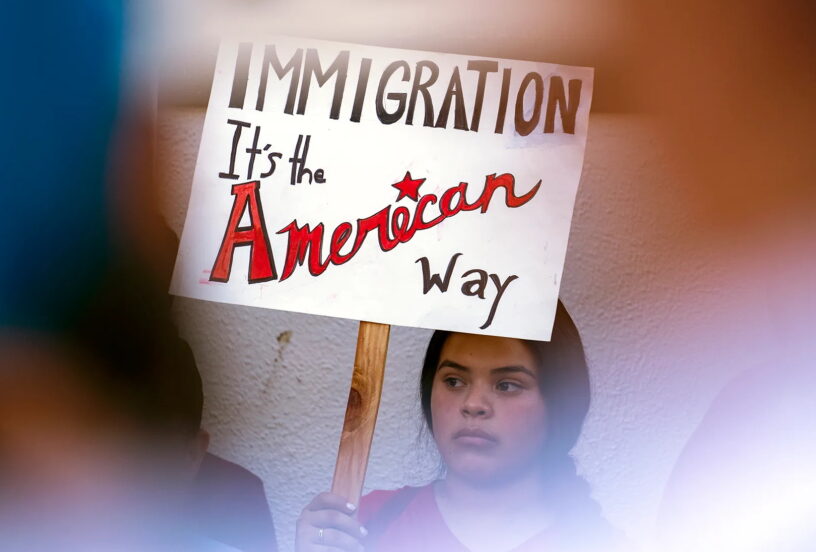
That is the American Way.

